
 RightLawIndia Team
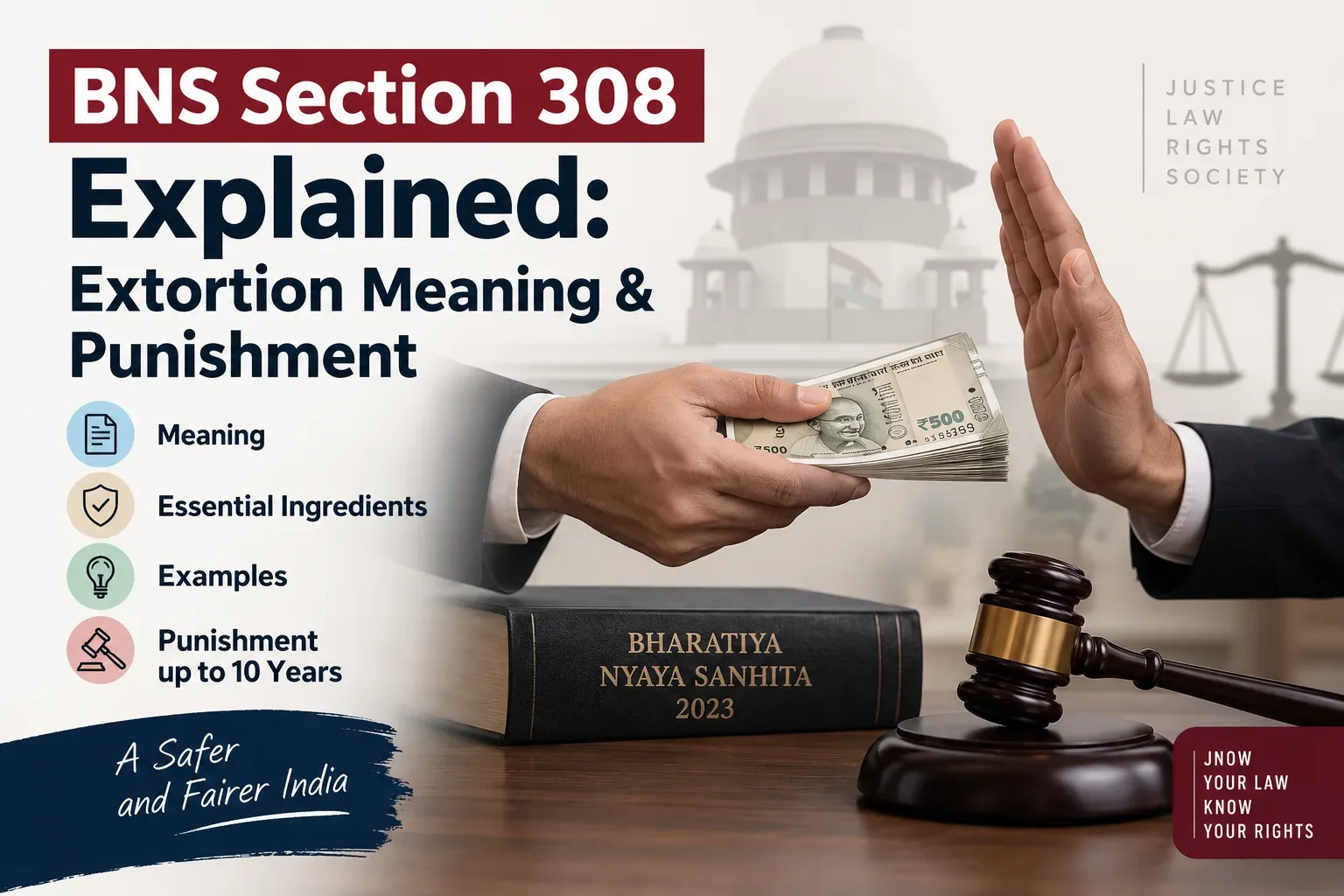
Extortion is one of the most commonly reported property offences in India, ranging from threatening phone calls demanding money to online blackmail over private photos or data. Under India's new criminal code, this offence is governed by BNS Section 308, which replaces Section 383 of the erstwhile Indian Penal Code, 1860. This article breaks down what BNS Section 308 actually says, how courts interpret its language, real-life illustrations, and the punishment prescribed for each stage of the offence — from a mere threat to a completed act of extortion.
What Is BNS Section 308?
In simple terms, BNS Section 308 deals with the criminal offence of extortion — a situation where one person forces another to hand over money, property, or a valuable document by putting them in fear of injury. Unlike theft or robbery, where property is taken by force or stealth, extortion under BNS Section 308 works through psychological pressure: the victim technically "consents" to give up the property, but that consent is obtained dishonestly, through fear.
Essential Ingredients of Extortion Under BNS Section 308
For an act to qualify as extortion under BNS Section 308, the prosecution must establish the following elements:
• Intentional creation of fear — the accused must deliberately put the victim (or someone connected to the victim) in fear of injury.
• Injury can be broad — it may be physical harm, damage to reputation, financial loss, or harm to property, not just bodily injury.
• Dishonest inducement — the fear must dishonestly induce the victim to act against their own interest.
• Delivery of property or valuable security — the victim must actually hand over property, money, or a document capable of being converted into a valuable security.
If any one of these ingredients is missing, the offence may fall under a different provision (such as criminal intimidation) rather than BNS Section 308.
Illustrations of Extortion Under BNS Section 308
The provision itself uses simple illustrations to explain how extortion plays out in real life:
1. Threatening to publish defamatory content about a person unless they pay money.
2. Threatening to wrongfully confine someone's child unless a promissory note is signed in the offender's favour.
3. Threatening to destroy a person's crop or property unless they sign a bond agreeing to deliver goods.
4. Forcing a person, through fear of grievous hurt, to sign a blank paper that can later be converted into a valuable document.
5. Sending a digital or telephonic threat — for example, claiming to have kidnapped someone's child — to extract a ransom amount.
These illustrations show that BNS Section 308 is drafted broadly enough to cover modern threats too, including WhatsApp messages, emails, and calls used for ransom, sextortion, or data-leak blackmail.
Punishment Under BNS Section 308
BNS Section 308 prescribes graded punishment depending on the severity and stage of the threat:
• Simple extortion: Imprisonment up to 7 years, or fine, or both.
• Putting a person in fear (attempt stage): Imprisonment up to 2 years, or fine, or both.
• Attempt through fear of death or grievous hurt: Imprisonment up to 7 years, along with fine.
• Actual extortion through fear of death or grievous hurt: Imprisonment up to 10 years, along with fine.
• Attempt through fear of a serious accusation (offence punishable with death, life imprisonment, or up to 10 years): Imprisonment up to 10 years, along with fine.
• Actual extortion through fear of such a serious accusation: Imprisonment up to 10 years, along with fine.
The graded structure of BNS Section 308 shows that punishment increases sharply when the threat involves death, grievous hurt, or a false accusation of a serious crime, reflecting how much more coercive and dangerous such threats are.
How BNS Section 308 Differs From Robbery and Criminal Intimidation
People often confuse extortion with robbery or criminal intimidation. The key difference is that BNS Section 308 requires the victim to actually part with property because of fear — it is a property offence achieved through coercion, not physical snatching. Robbery, on the other hand, typically involves the use or threat of instant force at the time of the taking. Criminal intimidation, by contrast, does not require any property to actually change hands — a threat alone is enough for that offence, whereas BNS Section 308 is only complete once property or a valuable security is delivered (though attempts are separately punishable).
Is Extortion Under BNS Section 308 Bailable?
Extortion under BNS Section 308 is generally treated as a cognizable and non-bailable offence, meaning police can register an FIR and arrest without a warrant, and bail is granted at the discretion of the court rather than as a matter of right. The exact bail outcome depends on the facts of the case, the severity of the threat involved, and the accused's criminal history, so a magistrate or sessions court evaluates each application individually.
What to Do If You Are a Victim of Extortion
• Preserve all evidence of the threat — call recordings, screenshots of messages, emails, or documents.
• Avoid making any payment or signing any document under pressure, if it is safe to do so.
• File a police complaint or FIR promptly, citing BNS Section 308 where the facts fit.
• Consult a criminal lawyer to understand whether the facts point to extortion, criminal intimidation, or cheating.
• In cases involving digital threats, report the matter on the National Cyber Crime Reporting Portal alongside the police complaint.
Conclusion
BNS Section 308 continues the legal legacy of Section 383 IPC while sharpening its language and graded punishment structure to address both traditional and digital forms of extortion. Whether the threat is a defamatory post, a fake kidnapping message, or pressure to sign away property, the essence of the offence remains the same — dishonest inducement through fear. Understanding the ingredients, illustrations, and punishment under BNS Section 308 helps both victims and the accused understand where they stand legally, and why timely legal advice matters in such cases.
Frequently asked questions
Comments on BNS Section 308 Explained: Extortion Meaning, Ingredients and Punishment
0 commentsOnly verified members can comment.
No comments yet — start the discussion.